Home / The Problem-Solving Toolkit
The Problem-Solving Toolkit
35 Consulting Methods for Defining, Analyzing, and Solving Business Problems
- How to frame a messy problem before solving it, from the problem statement to SCQA and issue trees
- 35 consulting methods, including MECE, Five Forces, the Ansoff matrix and ICE scoring
- Practical tools like driver trees, Five Whys, decision trees and the Pyramid Principle
- One worked case (Corbel Supply Co.) across every chapter, plus an exercise and a template sheet in each
Choose how you want to start:
About The Problem-Solving Toolkit
Whether you're a manager, an analyst or a consultant early in your project work, this book gives you a repeatable problem-solving framework that takes a business problem from a vague question to a clear recommendation.
It walks through the whole problem-solving workflow, from framing the question to delivering the plan, in four stages: Frame, Find, Decide, Deliver. It uses 35 consulting methods, each explained in plain English and shown on one worked case.
Covering problem framing, analysis, decision-making and communication, every chapter ends with a Try It exercise, an answer guide and a template sheet, so the method is ready to use the next time a problem lands.
What's inside: the problem-solving method, chapter by chapter
35 chapters in 6 parts.
Part I · Frame the Problem (Frame, 6 chapters)
- 1The Problem Statement: Write the Question Before You Chase the Answer
- 2SCQA: Tell the Story of the Problem in Four Moves
- 3MECE: Split a Problem with No Gaps and No Overlaps
- 4Issue Trees: Turn One Big Question into Pieces You Can Assign
- 5Hypothesis-First Thinking: Start with a Best Guess and Try to Kill It
- 6Stakeholder Interviews That Surface the Real Issue
Part II · Find the Facts (Find, 7 chapters)
- 7Driver Trees: Trace a Number Back to What Moves It
- 8The 80/20 Lens: Find the Few Things That Matter Most
- 9Five Whys: Dig Past the Symptom
- 10Fishbone Diagrams: Map Every Possible Cause Before Choosing One
- 11Process Maps: See Where Work Waits
- 12Estimation and Market Sizing: Good-Enough Numbers, Fast
- 13The Analysis Plan: Decide What to Prove Before You Open a Spreadsheet
Part III · Read the Landscape (Find, 6 chapters)
- 14PESTLE: Scan the Forces Outside the Building
- 15Five Forces: Understand Why an Industry Makes (or Loses) Money
- 16SWOT That Leads Somewhere: From Lists to Strategic Moves
- 17The Value Chain: Find Where Value Is Created and Lost
- 18Benchmarking: Compare Fairly, Learn Honestly
- 19The 7-S Check: Is the Organization Built to Deliver the Strategy?
Part IV · Choose What to Do (Decide, 7 chapters)
- 20Generating Options: Widen the Field Before You Narrow It
- 21The Ansoff Matrix: Map Your Growth Paths and Their Risk
- 22The Growth-Share Matrix: Manage a Portfolio, Not a Collection
- 23Impact vs. Effort: Sort a Long List in One Meeting
- 24Scoring Models: ICE and Weighted Criteria Without Fooling Yourself
- 25Decision Trees and Expected Value: Choosing Under Uncertainty
- 26Risk Registers and Pre-Mortems: Plan for What Could Go Wrong
Part V · Test and Design (Decide, 4 chapters)
- 27Pilots and Experiments: Learn Cheaply Before You Bet Big
- 28Business Model Mapping: See How the Pieces Make Money
- 29Pricing Choices: Cost-Plus, Competitive, and Value-Based
- 30Unit Economics: Does Each Sale Actually Pay?
Part VI · Communicate and Deliver (Deliver, 5 chapters)
- 31The Pyramid Principle: Lead with the Answer
- 32Storylines and Action Titles: Slides That Make an Argument
- 33RACI and Stakeholder Maps: Who Decides, Who Does, Who Needs to Know
- 34Roadmaps, Gantt Charts, and Kanban: Turn a Plan into Motion
- 35Keep It Working: OKRs, KPIs, and Continuous Improvement
Every chapter follows the same pattern: the problem it solves, the steps, a done-test, one example from the Corbel Supply Co. case, common mistakes and limits, a Try It exercise with an answer guide, and a template sheet. Read it front to back, or start at the chapter that matches the problem on your desk.
3 ITEMS INCLUDED
The Complete Kit
The book, the Field Kit and the Editable Templates, ready the moment you pay. $69 for all three.
Everything in one bundle: $69 (save $9 vs. buying separately).
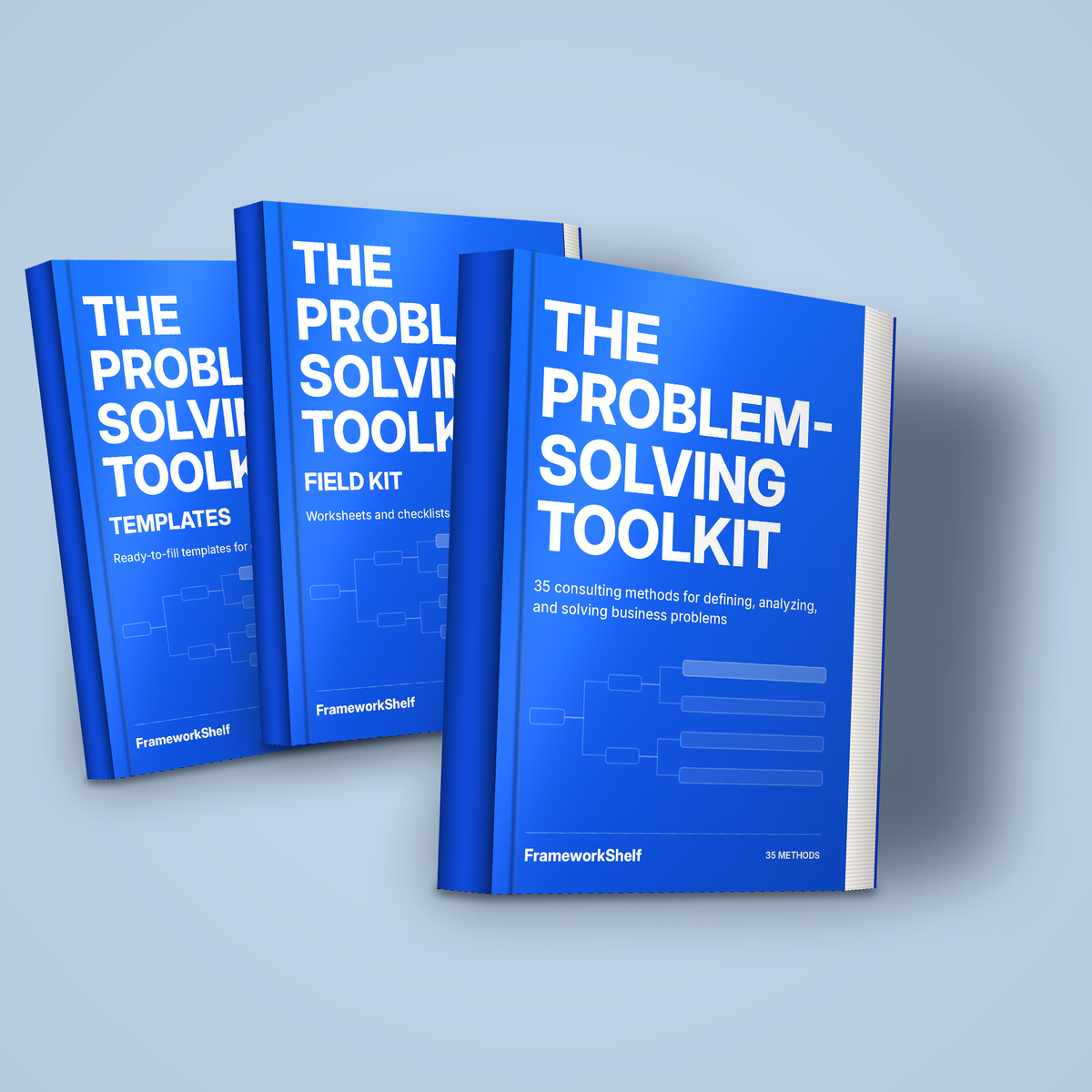
- The Problem-Solving Toolkit (PDF + EPUB)$49
- Field Kit$12
- Editable Templates$17
$78 if bought separately
Complete Kit, all three: $69
Read it, print the page you need, fill in the template.
One method: Frame, Find, Decide, Deliver
Every chapter fits one stage of a single workflow, so the book reads as a process, not a pile of frameworks. Frame the problem until the question is clear enough to assign. Find the facts that matter, and the forces around them. Decide among real options, and test the choice cheaply before betting on it. Deliver it as a recommendation people can act on, and a plan with names attached. When new facts show up, go back a stage. That's normal, and the book shows where to re-enter.
Stage 1
Frame
Part I · Frame the Problem
Stage 2
Find
Part II · Find the Facts
Part III · Read the Landscape
Stage 3
Decide
Part IV · Choose What to Do
Part V · Test and Design
Stage 4
Deliver
Part VI · Communicate and Deliver
See 10 sample pages
Real pages from the book, as they appear in the PDF.
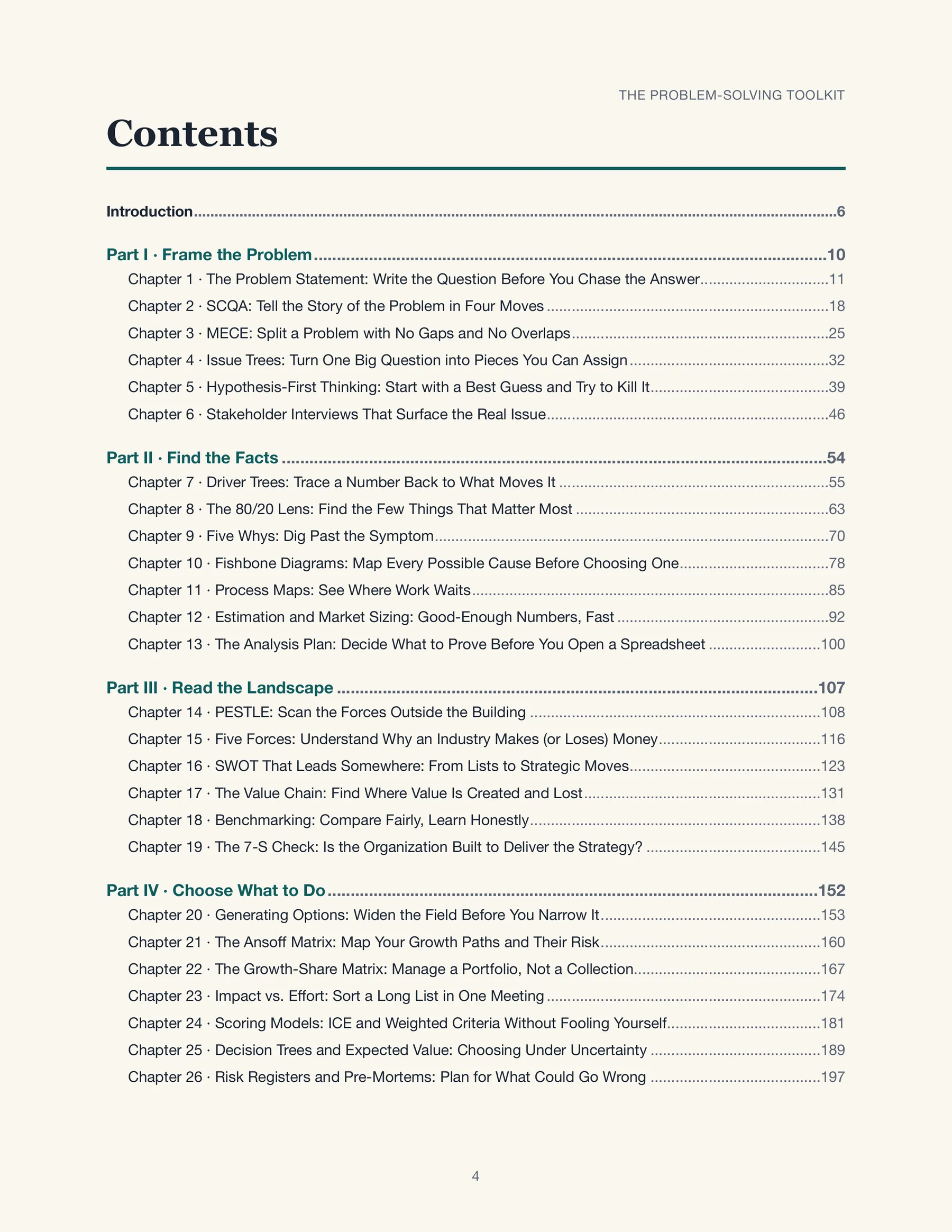
Sample page 4, Table of contents
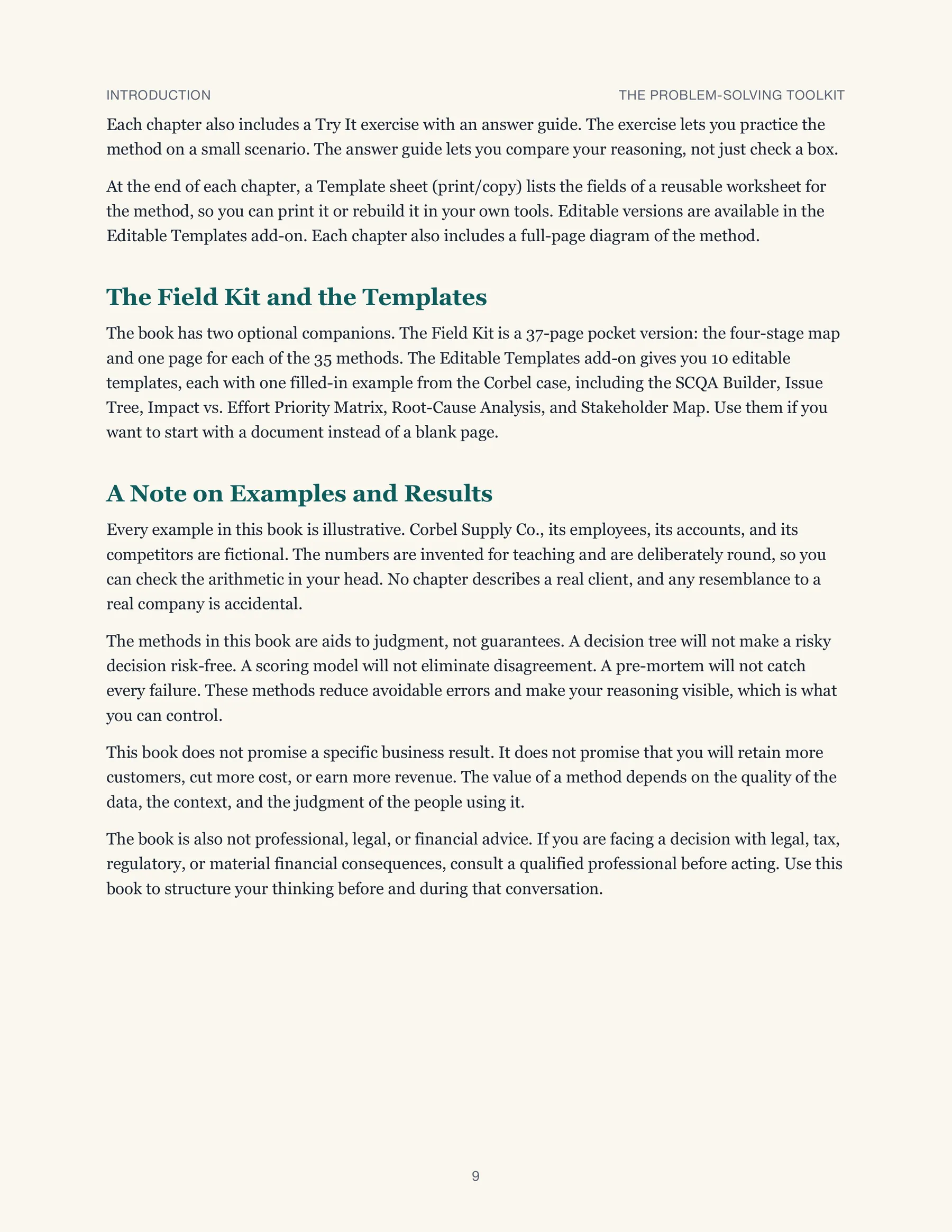
Sample page 9, Introduction: how every chapter is built
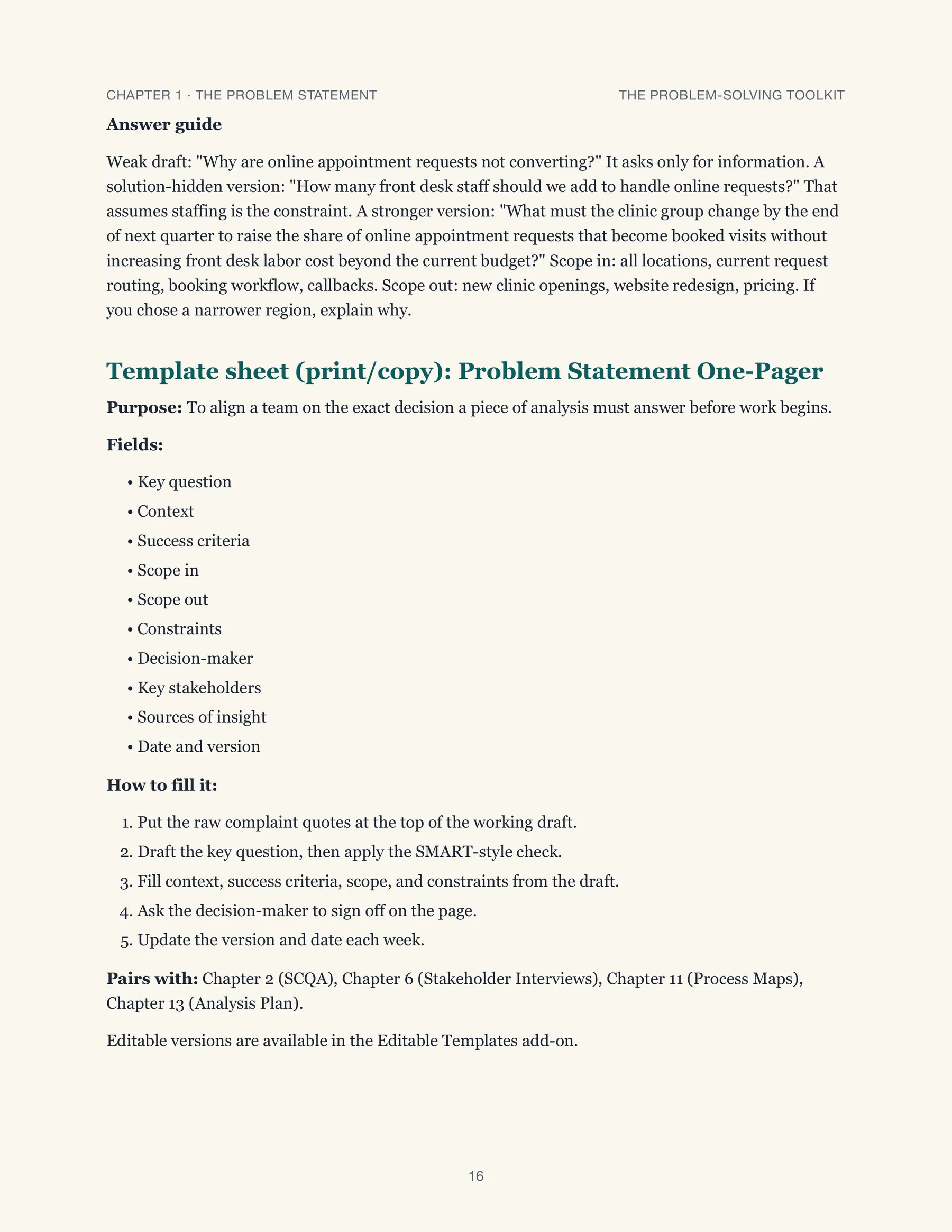
Sample page 16, Chapter 1: Try It answer guide
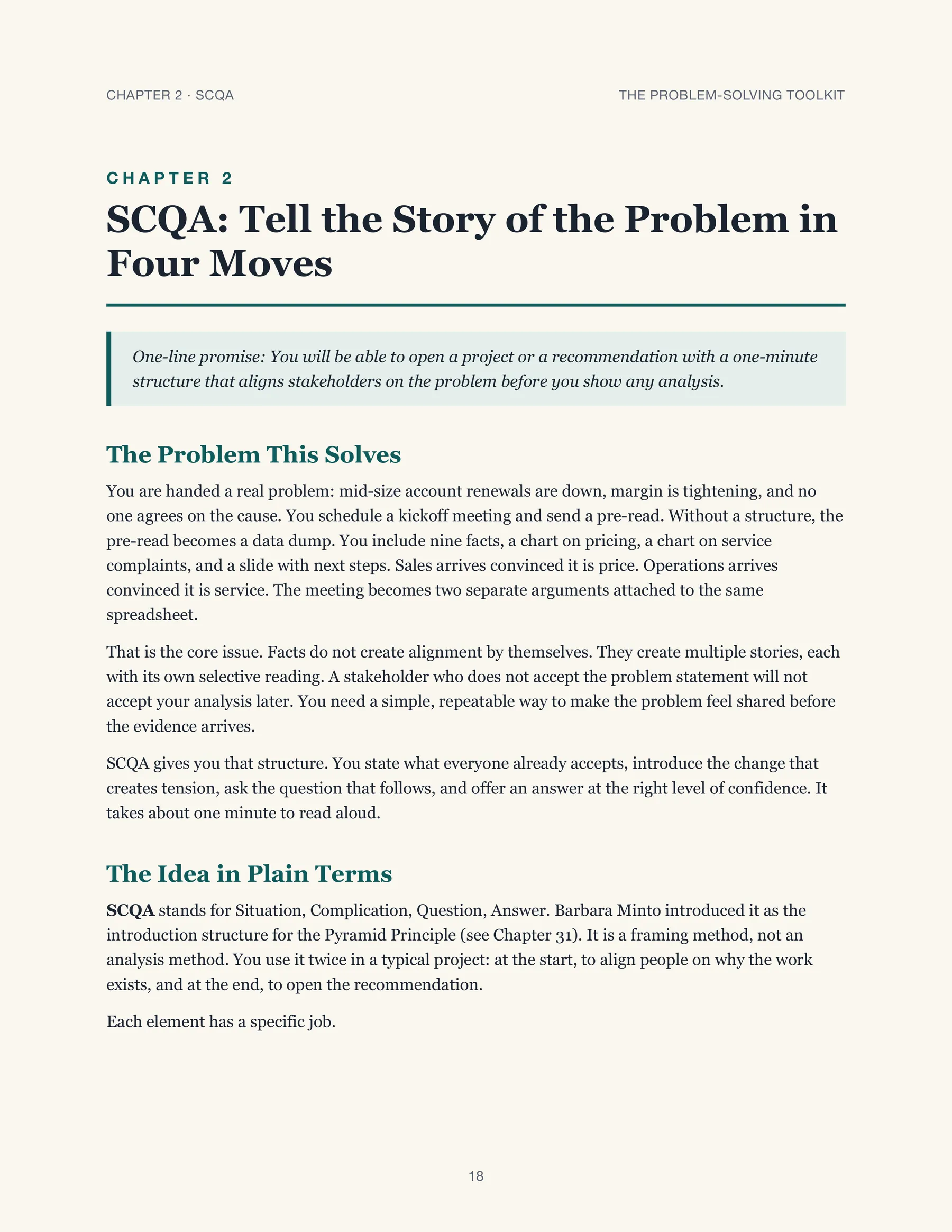
Sample page 18, Chapter 2: SCQA
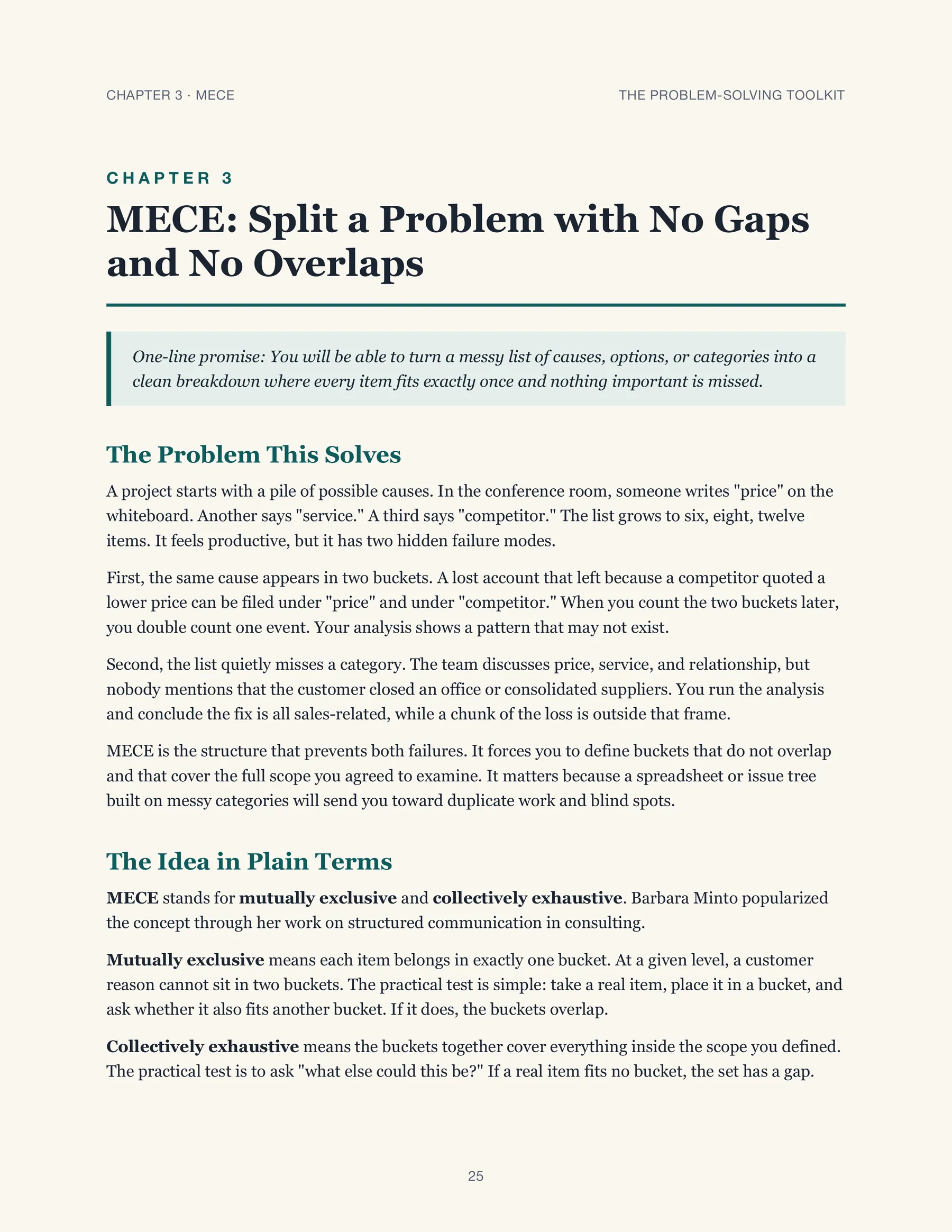
Sample page 25, Chapter 3: MECE
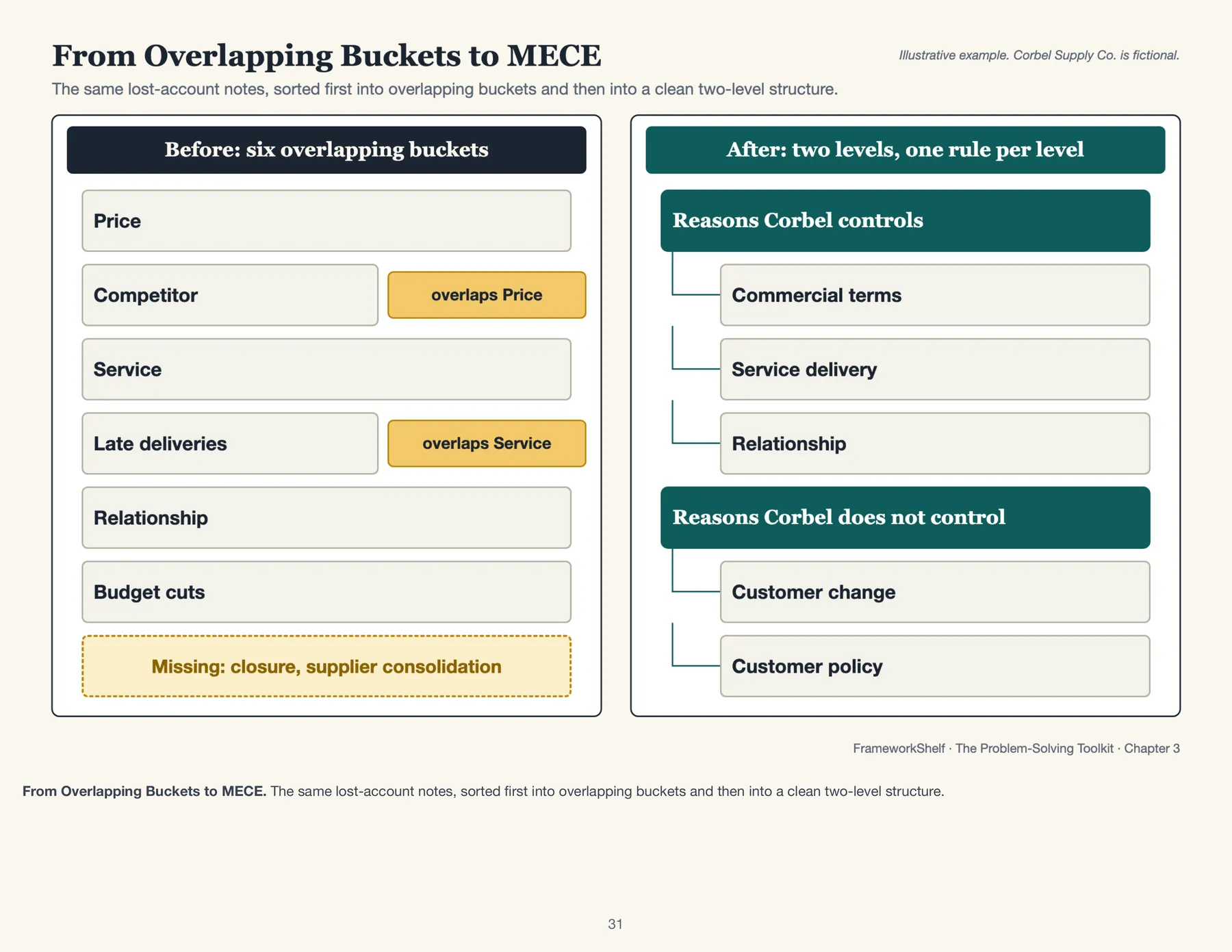
Sample page 31, Chapter 3: From Overlapping Buckets to MECE (diagram page)
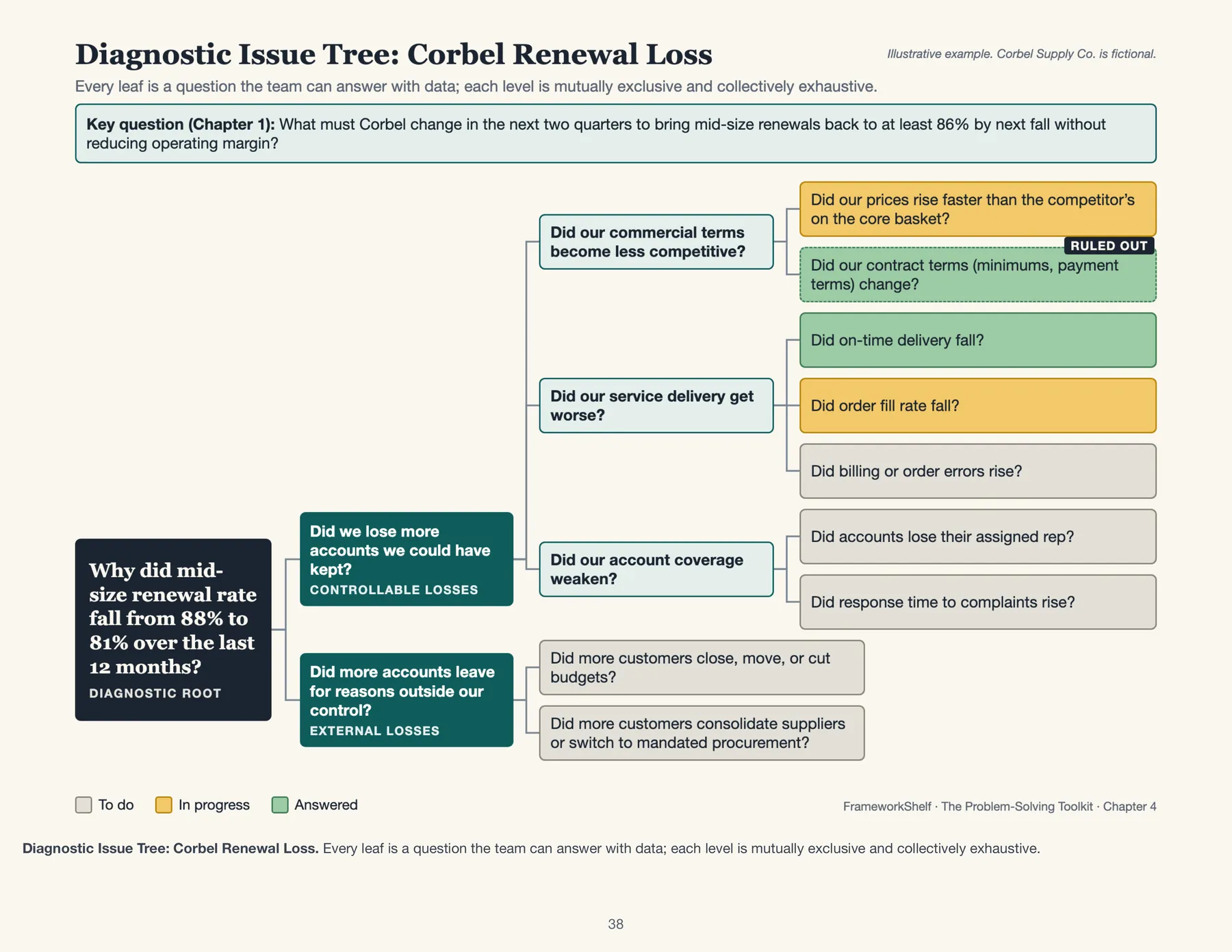
Sample page 38, Chapter 4: Diagnostic Issue Tree (diagram page)
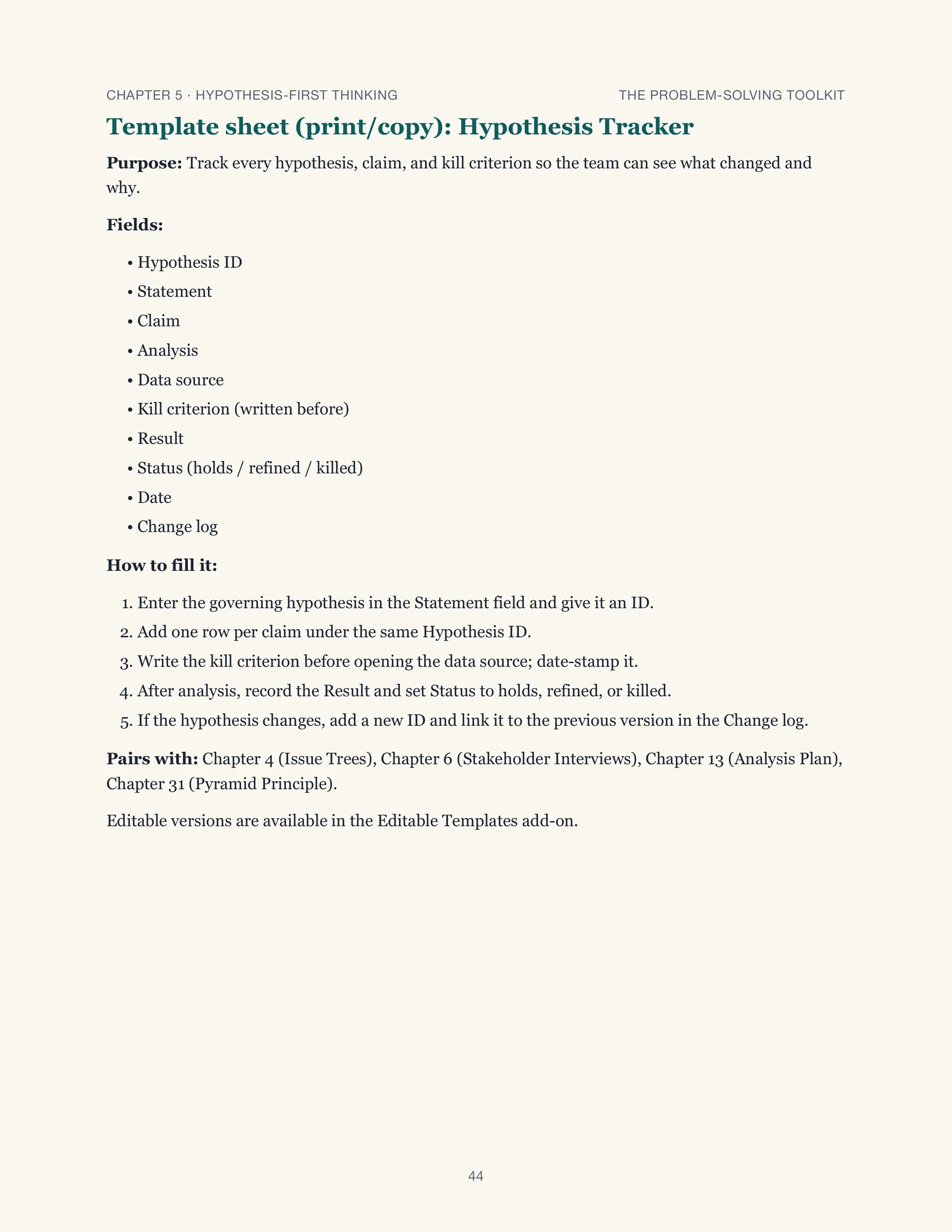
Sample page 44, Chapter 5 template sheet: Hypothesis Tracker
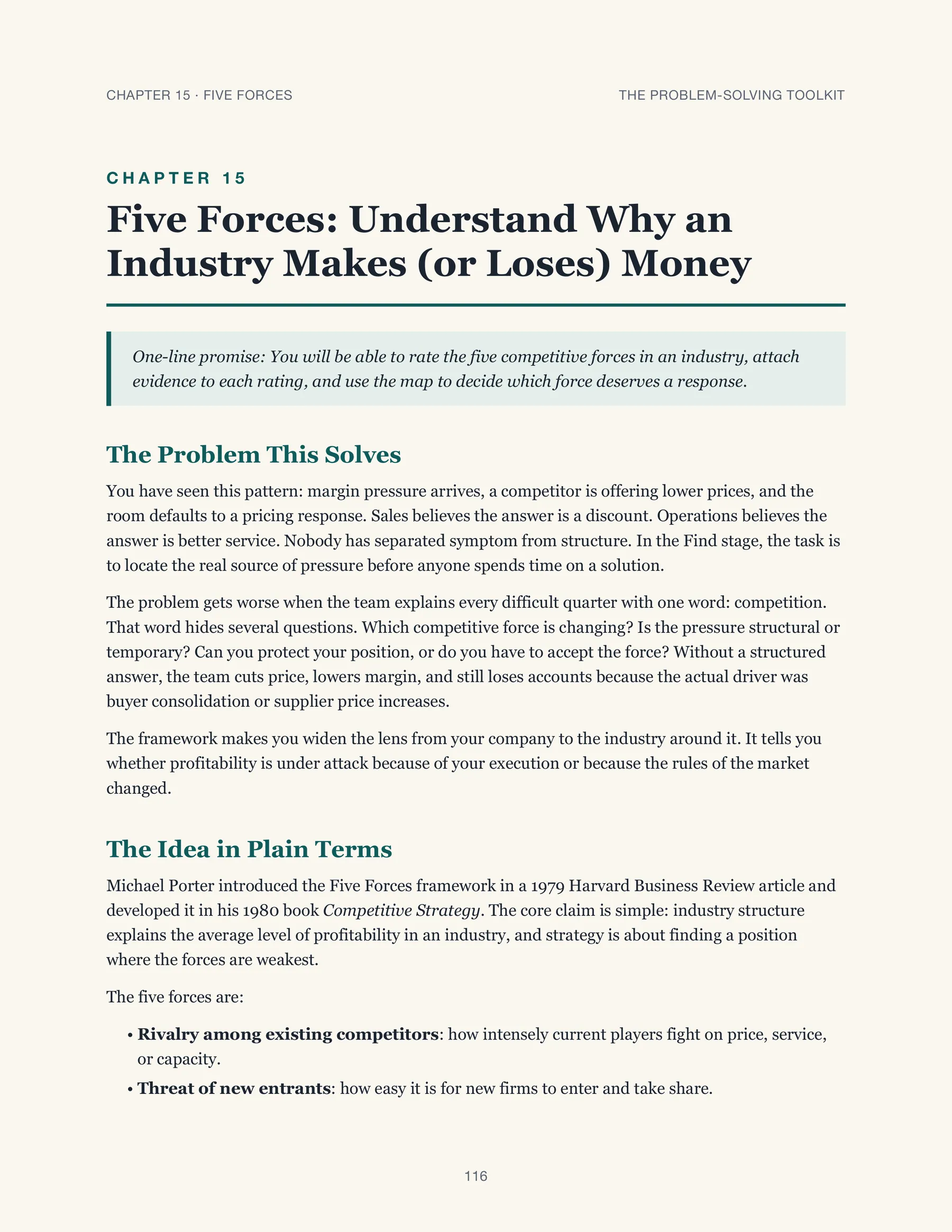
Sample page 116, Chapter 15: Five Forces
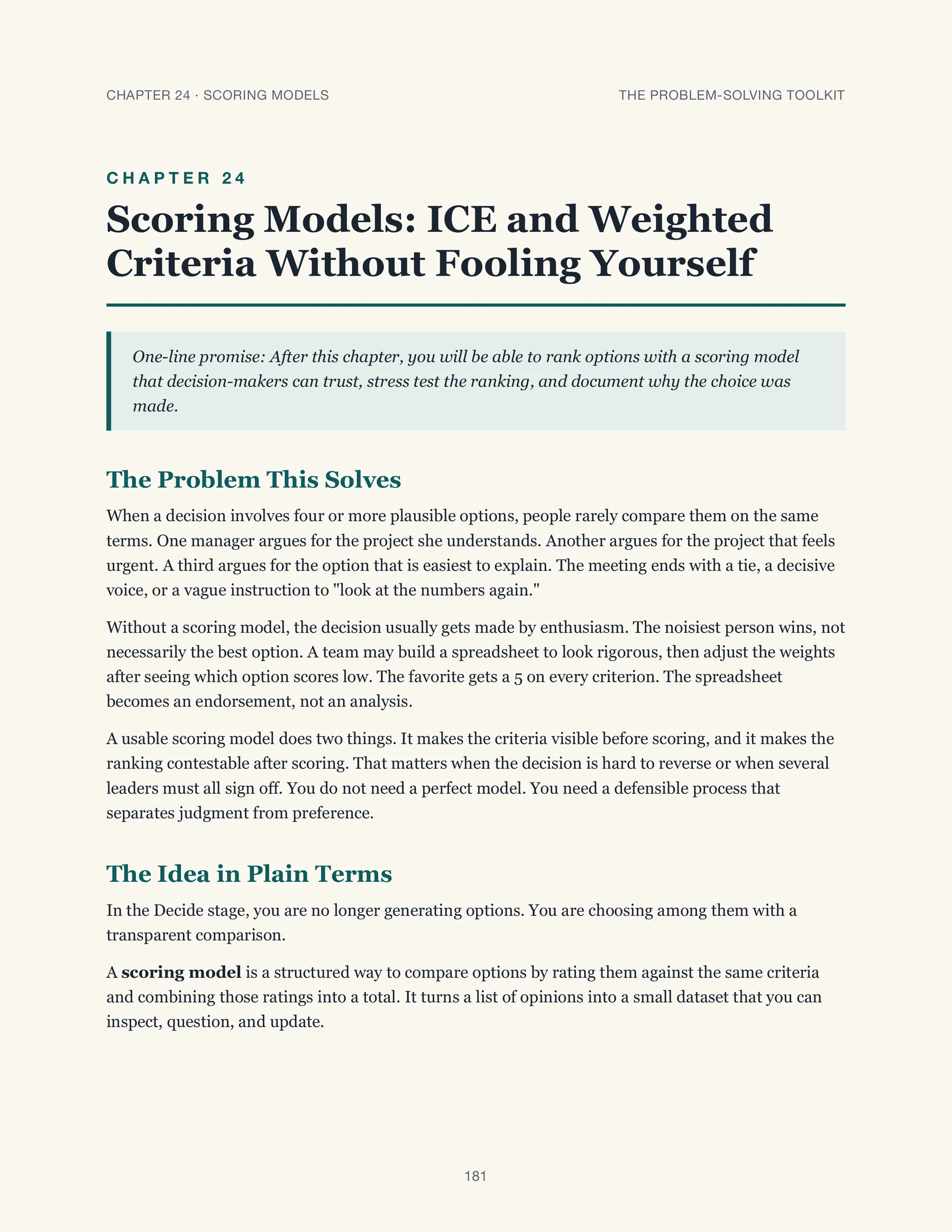
Sample page 181, Chapter 24: Scoring Models
From the book
“A business problem is a gap between the performance you have and the performance you are accountable for, with a decision attached. You can usually see the gap in a number.”
Introduction, page 6
“Scope is what makes exhaustiveness possible. You cannot be exhaustive about “all reasons for everything.” You can be exhaustive about “reasons a mid-size account did not renew in the last 12 months.” Define the whole first, then split it.”
Chapter 3 · MECE, page 26
“SCQA frames a problem; it does not analyze it.”
Chapter 2 · SCQA, page 22
14-day money-back guarantee
If the Products aren't useful to you, email support@frameworkshelf.com within 14 days of purchase and ask for a refund. You'll get the full amount back for that order, add-ons included. No form to fill in. Refunds go back through Paddle, our Merchant of Record, to the original payment method. This doesn't affect any statutory rights you have.
Read the Refund Policy