35 Consulting Methods, Arranged in the Order You Actually Use Them on a Hard Business Problem
FrameworkShelf · October 2026

Some of the most used tools in management came out of consulting firms: RAPID from Bain, the growth-share matrix from BCG, the 7-S model from McKinsey. They have steered big decisions for decades, yet most managers run into them by accident, one at a time, if they meet them at all.
Behind them sits a plain routine of structured problem solving. Pin down the question. Collect only the facts that answer it. Weigh a few real options. Hand over a recommendation someone can act on. The order doesn't change, whether the issue is customers leaving, a price to set or a process that keeps failing.
Each step has a single job and passes its result to the next one. No sticky-note wall, no deck padded for safety.
Outside advisers bill serious fees to run that routine for a client. Their edge isn't raw brainpower. They were drilled in the order of the steps, and most teams were left to work it out alone.
The methods themselves are public. Porter published the Five Forces in 1979, and many of the others are just as old. What's missing is one place that teaches them together, in the order you would actually use them.
A degree splits them across semesters. A typical business book stretches a single idea over a whole volume. Online, each article covers one framework in its own jargon. At work, you're supposed to absorb them along the way.
The result is improvisation: experience, every spreadsheet within reach, and the hope that the reasoning survives the first tough question from a senior colleague.
On routine work, that's enough. On the problems that matter most, it's where things come apart.
Where capable people get stuck on hard questions
Picture the most recent problem at work that had no obvious owner and no obvious answer.
Sales in one region dipped and every manager had a different theory. Or you were asked for a recommendation by Thursday while the spreadsheets told three different stories. Or the same agenda item kept coming back to the weekly meeting, month after month.
What happened next? If it went the usual way: a search, a template from an old project, a few frameworks half-remembered from a training, stitched together into something that looked reasonable. And then the meeting.
After hours, in the search bar
What gets typed once the office has gone quiet
“how do I get my team to agree on what the problem is”
Ch. 1 · Problem Statement“why did our numbers drop this quarter”
Ch. 7 · Driver TreesCh. 9 · Five Whys“which project do we fund first”
Ch. 23 · Impact vs. EffortCh. 24 · Scoring Models“is this market worth getting into”
Ch. 15 · Five ForcesCh. 12 · Estimation and Market Sizing“how to write a recommendation slide people actually read”
Ch. 31 · Pyramid PrincipleCh. 32 · Storylines and Action Titles“who is supposed to own this”
Ch. 33 · RACI and Stakeholder Maps
Each of those searches opens a dozen tabs that disagree with each other. Each one also has a chapter that takes it from the top.
That's not a method. That's improvising under a deadline.
The gap between “works hard and knows the numbers” and “works a hard problem through a clear sequence” is seldom talent. It's a routine you can repeat: split the question into parts, check what the facts actually say, and assemble a recommendation that survives a hard follow-up.
Consulting firms tend to drill that routine into their people early. Outside those firms, people usually assemble it piece by piece, from articles and from whatever a good manager happened to show them. The methods were never secret; they were just never arranged in one sequence you could pick up and follow.
Making it up as you go
Working the sequence
No question written down.
Weeks of work aimed at a moving target
Pin the question first.
Write it, then tell it in four moves (Ch. 1–2)
Read everything in sight.
Piles of reports and no way to sort them
Split it into clean pieces.
Each piece separate, all of them complete (Ch. 3–4)
Fix whatever looks broken.
The obvious suspect, rarely the real one
Follow the number down.
From the result to what actually drives it (Ch. 7, 9)
The senior opinion settles it.
Rank set by title, not by merit
Rate every option in the open.
Impact, confidence and ease on one page (Ch. 23–24)
Walk in with a pile of slides.
Findings in order, the point at the end
Put the answer on top.
The support goes underneath it (Ch. 31)
Ship it and move on.
Nobody checks whether it stuck
Give every step an owner.
Who decides, what comes next, how you'll know (Ch. 33–35)
Where it lands: unclear.
“Let's take this offline.”
Where it lands: a decision.
Owners, next steps
The Problem-Solving Toolkit and the Complete Kit are an instant download (PDF + EPUB).
The Complete Kit: book, Field Kit and templates
The book, the Field Kit and the Editable Templates, in one order.
Everything in the Complete Kit
- The Problem-Solving Toolkit (PDF + EPUB): 35 methods, 35 diagrams
- Field Kit: 37 pages: a cover, a one-page map of Frame, Find, Decide, Deliver, and one page per framework
- Editable Templates: 10 editable templates, each with one filled-in example (Google Docs, Sheets, Slides)
$69 one payment
Everything in one bundle: $69 (save $9 vs. buying separately).
Get the Complete Kit: $69 →✓ Covered: full refund within 14 days
— OR JUST THE BOOK —
The Problem-Solving Toolkit: just the book
35 Methods35 DiagramsInstant PDF + EPUBTemplate sheet per chapter
- SCQA, MECE, issue trees and hypothesis-first thinking
- Driver trees, the 80/20 lens, Five Whys, Five Forces
- Impact vs. effort, ICE scoring, decision trees, pilots
- One worked case across all 35 chapters
$49 one payment
Get the Toolkit: $49 →✓ Covered: full refund within 14 days
Think back over the last few months
Moments that follow you home from work
Someone asked for your recommendation, and you answered with a long tour of the background.
Ch. 31 Pyramid Principle, in Part VI: Communicate and Deliver
Open with the answer and stack the support underneath, so the point lands before anyone drifts.
The fix the whole team signed off on last spring never moved the result it was meant to move.
Ch. 7 Driver Trees, in Part II: Find the Facts
Break the result into what actually drives it, then check which branch changed before picking a cure.
The options were debated in circles until the most senior person simply picked one.
Ch. 24 Scoring Models, in Part IV: Choose What to Do
Rate every option against the same criteria where everyone can see them, so the choice can be explained later.
Weeks into the project, a director asked which question all this work was answering.
Ch. 1 Problem Statement, in Part I: Frame the Problem
Write the question down on day one and get it agreed before a single spreadsheet is opened.
None of this comes down to talent. Each one is a step that was skipped, and each step has a chapter.
Quick check: where you are stuck
Where does your problem actually start?
1. Pick the situation closest to yours right now.
2. When a problem like that lands, what happens first?
3. What would change the outcome fastest?
Everything you just picked is a chapter, not a search.
Read the chapters behind your answers →A walk through one problem, start to finish
In the book, each problem travels the same four stages, always in the same order, whether it's a pricing question or a broken process.
Frame (Part I, Ch. 1–6): define the problem before solving it. Output: a question clear enough to assign, and a first guess worth testing.
Find (Parts II–III, Ch. 7–19): get the facts and read the forces around them. Output: facts you can stand behind.
Decide (Parts IV–V, Ch. 20–30): generate options, choose, and test cheaply. Output: a defensible choice with its risks visible.
Deliver (Part VI, Ch. 31–35): communicate and execute. Output: a recommendation and a plan with names on it.
Look inside the four stages →$49 · instant PDF + EPUB · 35 chapters
Stage one is getting the question right. Teams skip it all the time, debating fixes while each person quietly pictures a different problem. SCQA (Situation, Complication, Question, Answer) makes the group settle the question first, in four short moves. Barbara Minto introduced it as the opening structure for the Pyramid Principle.
The chapter shows it twice in a project: at the kickoff, to align people on why the work exists, and at the end, to open the recommendation.
Read how SCQA frames a problem →$49 · instant PDF + EPUB · 35 chapters
With the question settled, MECE splits it into pieces that don't overlap and, taken together, leave nothing out (mutually exclusive, collectively exhaustive). Each item goes in exactly one bucket, and the buckets together cover everything in scope. The chapter gives two practical tests: place a real item and ask whether it also fits another bucket (overlap); ask “what else could this be?” (gap).
The MECE chapter, with both tests →$49 · instant PDF + EPUB · 35 chapters
After that, the path depends on the kind of problem you're holding.
Is the question about competitors and margins? Porter's Five Forces looks at the five sources of pressure on an industry's profits: rivalry, new entrants, buyers, suppliers and substitutes. The chapter's core point is that industry structure explains average profitability, and strategy is about finding the position where the forces are weakest.
Read the full Five Forces walkthrough →$49 · instant PDF + EPUB · 35 chapters
More ideas on the table than money to fund them? Give each one three scores from 1 to 10, for impact, confidence and ease: that's ICE. The chapter shows when to average the scores and when to multiply them (multiplying punishes one weak score), and when to switch to a weighted model for bigger choices.
Browse the other methods too →$49 · instant PDF + EPUB · 35 chapters
Want the plan carried out, not just approved? Part VI covers the delivery methods. They aren't buzzwords; each comes with steps, a done-test and a template sheet.
How the book handles delivery
- Pyramid Principle: lead with the answer (Ch. 31)
- Storylines and action titles: slides that make an argument (Ch. 32)
- RACI and stakeholder maps: who decides, who does, who needs to know (Ch. 33)
- Roadmaps: outcomes by quarter (Ch. 34)
- Gantt charts and the critical path: what must finish first (Ch. 34)
- Kanban and WIP limits: what to work on now, what's blocked (Ch. 34)
- OKRs and KPIs: leading vs. lagging indicators (Ch. 35)
- PDCA and Kotter's steps: keep the fix working (Ch. 35)
For each, you get the steps, not just a definition.
Put together, these are working tools: a way to keep your reasoning straight when the pressure is on, and to hand over a recommendation that survives the tough questions.
Start-of-week check
Five situations. Which chapter would you reach for first?
1. A customer segment keeps drifting away and the quarterly review is next week.
Ch. 7 · Driver TreesCh. 9 · Five WhysTrace the falling number back to what drives it, then keep asking why until you reach something a team can change.
2. Your manager forwards a one-line email: “can you look into our pricing?”
Ch. 1 · Problem StatementCh. 29 · Pricing ChoicesTurn the vague request into a question someone could sign off on, then compare cost-plus, competitive and value-based pricing against it.
3. Three teams want the same budget for their own project.
Ch. 23 · Impact vs. EffortCh. 24 · Scoring ModelsPut every request on one grid, score the close calls in the open, and let the reasoning settle it instead of the loudest voice.
4. A new process went live and work now piles up between two teams.
Ch. 11 · Process MapsCh. 33 · RACI and Stakeholder MapsDraw where the work waits, then agree who decides, who does the work and who only needs to hear about it.
5. Leadership likes a new product idea but nobody wants to bet the year on it.
Ch. 27 · Pilots and ExperimentsCh. 30 · Unit EconomicsDesign a small, cheap test with a clear pass mark, and check whether each sale would pay for itself before scaling.
Pick the one closest to your week. That chapter is where Monday starts.
What the new tools still leave to you
There's more data on every desk than ever, and tools that can draft an answer in seconds. What none of them do is decide which question is worth answering, check whether the logic holds, or get a room to agree on a call. That part is still the job. The methods in this book are for that part.
From the first question to the final plan, across 35 chapters
All of it sits in one book: The Problem-Solving Toolkit. Inside, the workflow runs from the opening question all the way to a plan with owners:
Every stage, in order
- 1. Frame the Problem · problem statements, SCQA, MECE, issue trees, hypotheses, interviews → know what you're solving
- 2. Find the Facts · driver trees, 80/20, Five Whys, fishbone, process maps, estimation, analysis plan → find what's actually happening
- 3. Read the Landscape · PESTLE, Five Forces, SWOT, value chain, benchmarking, 7-S → map the industry and your own organization
- 4. Choose What to Do · options, Ansoff, growth-share, impact vs. effort, ICE, decision trees, pre-mortems → pick and defend a choice
- 5. Test and Design · pilots, business model mapping, pricing, unit economics → test before betting big
- 6. Communicate and Deliver · Pyramid Principle, storylines, RACI, roadmaps, OKRs and KPIs → get it decided and done
Every method comes with its own diagram, 35 in all, simple enough to redraw on a whiteboard. And every chapter ends with a Try It exercise, an answer guide and a template sheet.
Jump in wherever your current problem is. Each chapter stands on its own, with pointers to anything it builds on.
Built to be used, not skimmed
Plenty of business books build a whole volume around one idea. This one does the opposite: 35 methods, each broken into steps, illustrated, and shown on the same worked case.
The aim is simple: fewer pages about thinking, more methods you can use on the problem in front of you.
Side by side
How the book stacks up against the usual ways to learn this
| What is included | This guide | Full-time degree | Paid online classes | Single-topic business books | Free articles and videos |
|---|---|---|---|---|---|
| Methods arranged in one order, from question to plan | Yes | Spread across semesters | Usually one topic per course | Usually one idea per book | Scattered, each in its own jargon |
| A diagram for every method | Yes | Varies by course | Varies by course | Now and then | Now and then |
| One worked case carried through every method | Yes | Many separate cases | Varies | Rarely | Rarely |
| Exercise, answer guide and template sheet in each chapter | Yes | Part of the coursework | Varies | Rarely | Rarely |
| Each chapter usable on its own | Yes | Courses build on each other | Modules build on each other | Chapters build on each other | Yes |
| How you pay | One-time price, instant download | Tuition | Subscription or per course | Pay per title | Free, paid for in time |
The Problem-Solving Toolkit is published by FrameworkShelf, a brand of AURELIAI SpA, and written by The FrameworkShelf Editorial Team. Each method is credited to its originators in its chapter.
Still with us?
If you've read this far, a specific problem is likely on your mind. Open the chapter that fits it tonight.
$49 one payment · PDF + EPUB
Get the Toolkit: $49 →- ✓ Encrypted payment page
- ✓ Download link right after payment
- ✓ Full refund within 14 days
See 10 sample pages
Real pages from the book, as they appear in the PDF.
Sample page 4, Table of contents
Sample page 9, Introduction: how every chapter is built
Sample page 16, Chapter 1: Try It answer guide
Sample page 18, Chapter 2: SCQA
Sample page 25, Chapter 3: MECE
Sample page 31, Chapter 3: From Overlapping Buckets to MECE (diagram page)
Sample page 38, Chapter 4: Diagnostic Issue Tree (diagram page)
Sample page 44, Chapter 5 template sheet: Hypothesis Tracker
Sample page 116, Chapter 15: Five Forces
Sample page 181, Chapter 24: Scoring Models
From the book
“A business problem is a gap between the performance you have and the performance you are accountable for, with a decision attached. You can usually see the gap in a number.”
Introduction, page 6
“Scope is what makes exhaustiveness possible. You cannot be exhaustive about “all reasons for everything.” You can be exhaustive about “reasons a mid-size account did not renew in the last 12 months.” Define the whole first, then split it.”
Chapter 3 · MECE, page 26
“SCQA frames a problem; it does not analyze it.”
Chapter 2 · SCQA, page 22
The next messy question deserves a method. Here are 35.
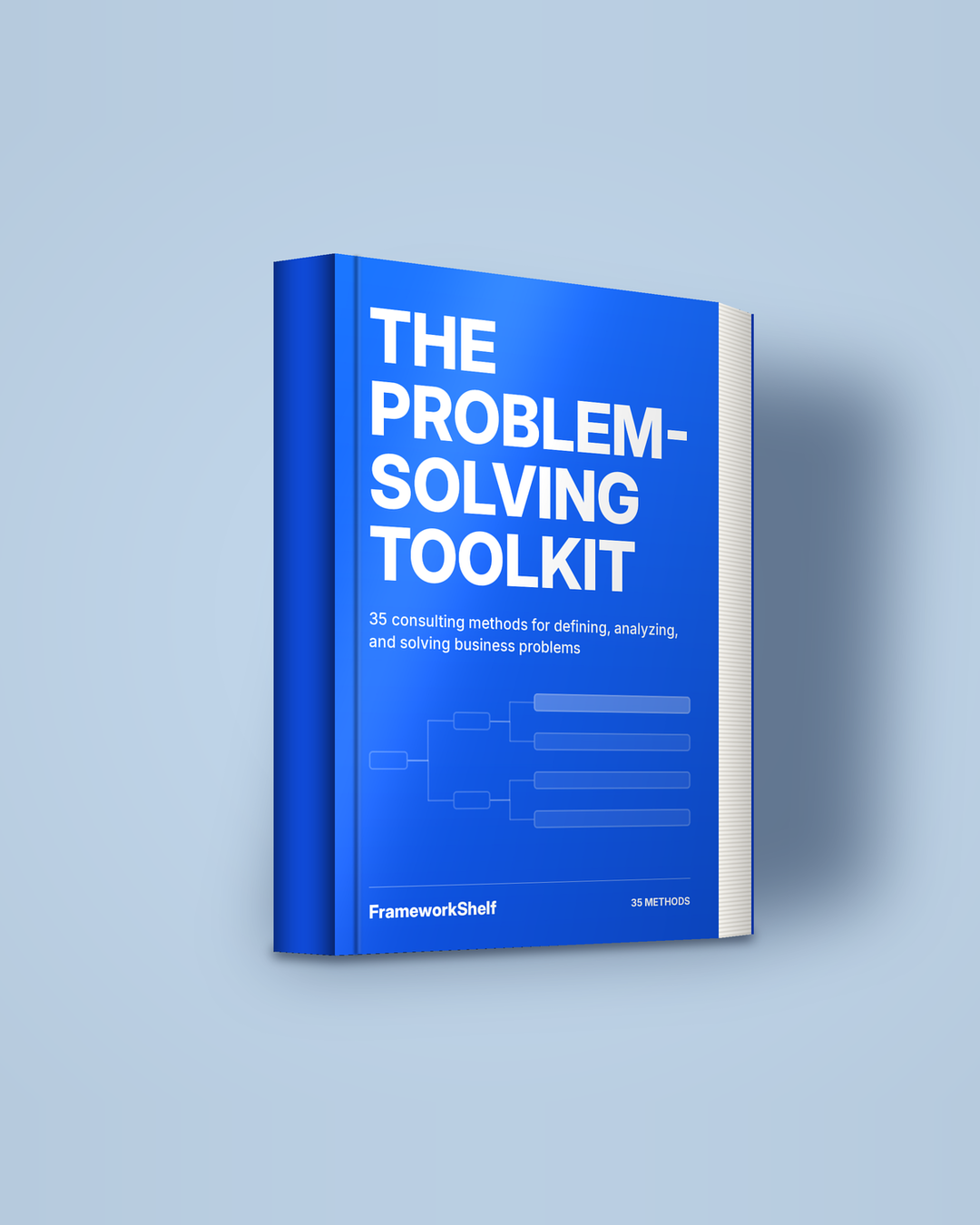
The Problem-Solving Toolkit · $49 one-time · PDF + EPUB, delivered instantly
Get the Toolkit: $49 →If it isn't useful, email us within 14 days for a full refund.